
“Other” Is Not a Reason Code
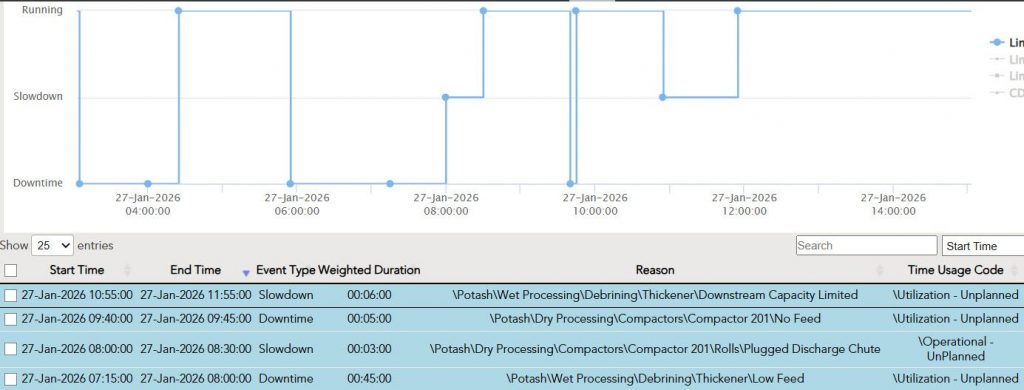 It’s a signal your downtime system isn’t doing its job.
Walk into almost any operation and look at their downtime data, and you’ll see the same familiar entries:
Other
No feed
Blocked
They’re everywhere.
And at first glance, they seem harmless. Even practical. After all, not every event fits neatly into a predefined category.
But over time, these codes do something subtle and damaging.
They strip your data of its ability to explain anything.
Because these aren’t really reason codes.
They’re placeholders.
The difference between describing events and explaining them
A good downtime system should answer a simple question:
Why did production stop?
But codes like “Other,” “No feed,” and “Blocked” don’t answer that.
They describe what happened at the surface level, not what caused it.
“Other” means we didn’t capture the reason
“No feed” means something upstream failed
“Blocked” means something downstream couldn’t take product
In every case, the real cause exists. It just hasn’t been captured.
And when that happens consistently, your dataset starts to degrade.
Not all at once. Gradually.
Until one day you realize you can’t confidently answer basic questions like:
What are our top losses?
Where should we invest?
Which team needs to act?
At that point, the system isn’t just incomplete. It’s misleading.
Why “Other” quietly breaks your analysis
“Other” feels like a safe fallback.
Operators can keep moving. The system stays simple. Nobody gets stuck trying to find the perfect code.
But when “Other” becomes a permanent category, it creates a blind spot in your operation.
Every “Other” entry is effectively lost information.
It can’t be trended.
It can’t be grouped.
It can’t drive action.
And the worst part is that it tends to grow over time.
As new failure modes emerge or edge cases appear, they get routed into “Other” instead of being formalized.
So the dataset becomes less useful the more you rely on it.
Shift #1: Treat “Other” as temporary, not permanent
The fix isn’t to eliminate “Other” entirely.
It’s to change how it’s used.
“Other” should be a temporary landing zone, not a final destination.
If someone selects “Other,” they should be required to add a comment explaining what happened.
That comment is not just context. It’s raw material for improving your system.
On a regular basis, those comments should be reviewed and converted into standardized reason codes.
Over time, this does two things:
Your code structure evolves to reflect reality
The percentage of “Other” decreases instead of increasing
That’s how you know your system is getting better.
Why upstream and downstream codes fall short
Codes like “No feed” and “Blocked” create a different kind of problem.
They point in the right direction, but they stop too early.
They tell you that the issue is external to the process. But they don’t tell you what actually happened.
And that’s where most teams unintentionally lose the thread.
Because the moment you stop at “No feed,” you’ve disconnected the downstream impact from the upstream cause.
Shift #2: Follow the cause across process boundaries
If a line stops due to “No feed,” the story doesn’t end there.
It starts there.
The real question is:
Why was there no feed?
And more importantly:
Who owns that cause?
Instead of stopping at a generic code, extend it into a causal chain:
No feed → Crusher apron feeder fault
No feed → Shovel 17 maintenance overrun
No feed → Low stockpiles
No feed → Truck shortage
Now the event is no longer abstract.
It’s tied to a specific failure, a specific asset, or a specific constraint.
And that changes what you can do with the data.
The same applies downstream:
Blocked → Waiting on third-party trains
Blocked → Packaging line 4 changeover
Blocked → Quality hold (fines content)
Blocked → Water usage restriction
Instead of a vague symptom, you now have a defined cause that someone can act on.
What happens when your codes start answering “why”
When reason codes move from surface-level descriptions to actual causes, the entire system becomes more useful.
A few things tend to happen almost immediately:
- Cross-process losses become visible
You can quantify how upstream and downstream issues impact finished production. - Ownership becomes clearer
Each loss is tied to a team, a system, or a decision point. - Conversations get shorter and more productive
Less time debating what happened. More time deciding what to do. - Improvement efforts become targeted
Instead of broad initiatives, teams can focus on specific, repeatable issues.
The hidden cost of vague codes
Vague codes don’t just reduce data quality. They shape behavior.
If the system allows ambiguity, people will use it.
And when ambiguity becomes the norm:
Accountability gets diluted
Root cause analysis gets skipped
The same problems repeat
Over time, the organization adapts to the limitations of the data instead of fixing them.
What good looks like
A strong downtime coding system does three things well:
It evolves as new issues appear
It captures causes, not just symptoms
It connects events across the value chain
It doesn’t need to be perfect.
But it does need to be intentional.
Final thought
“Other” isn’t just a category.
It’s a signal.
It tells you your system is missing something.
The same is true for “No feed” and “Blocked” when they stand alone.
If you want data that drives decisions, your codes need to answer “why,” not just “what.”
Because vague codes create vague accountability.
And specific codes create work that can actually be done.